
Your Essential Guide to the Schengen 90 Day Rule
Master the Schengen 90 day rule. This guide explains the rolling 180-day window, how to avoid costly mistakes, and how to track your stay automatically.
The Schengen 90/180-day rule is a critical regulation for non-EU/EEA citizens, allowing travel across the 29-country Schengen Area for up to 90 days within any 180-day period. The key challenge is its 'rolling' nature: the 180-day window constantly looks backward, making manual counting complex and risky. An automated, private solution like the DaysAround iOS App is the safest way to track your stay. It automatically builds a travel timeline on your device using your photos, providing an accurate, up-to-date count without sharing your data or using GPS, ensuring you stay compliant effortlessly.
Understanding the Schengen 90 Day Rule

Often called the "90-day rule," this regulation is the foundation of visa-free travel for millions visiting Europe for tourism or business. While the 90-day allowance is generous, the limit is strictly enforced. The rule is not based on a fixed six-month block; it's a dynamic, shifting window. To check your compliance today, you must look back over the last 180 days and sum up every day spent inside the zone.
The Schengen 90/180 Day Rule at a Glance
| Component | Explanation | How DaysAround Helps |
|---|---|---|
| The Limit | You can stay a maximum of 90 days in the Schengen Area. | The app gives a clear, real-time country counter of days used and days remaining. |
| The Window | This limit applies to any 180-day period. | It automatically calculates the rolling 180-day window, eliminating complex manual math. |
| The Calculation | You must always look backward from the current date to count your days. | The app builds a secure, on-device travel history, making past trip data instantly accessible. |
| Travel Days | Both your entry day and exit day count as full days. | DaysAround accurately logs every entry and exit from photo metadata, ensuring no days are missed. |
This table simplifies the rule, but the rolling window is where travelers often make mistakes, highlighting the danger of manual tracking. For quick planning, tools like our Schengen Zone Calculator Free are useful, but for ongoing compliance, an automated solution is superior.
Why Manual Tracking Fails
Relying on a notebook or spreadsheet to track your Schengen days is not just tedious—it's risky. A single forgotten weekend trip or a miscalculation can lead to an accidental overstay and severe penalties. The primary issue is the rolling nature of the 180-day window; the calculation changes daily, rendering static records unreliable.
The core challenge of the 90-day rule isn't the limit itself, but the constant need to recalculate your past 180 days. Every day you travel, the window shifts, making static calculations unreliable.
This is where a privacy-first, automated tool like the DaysAround iOS App makes all the difference. As a dedicated countries visited tracker, it removes the risk by securely building your travel timeline on your device using your photos. It doesn't need GPS or cloud uploads; your entire travel history remains completely private on your phone, providing peace of mind and foolproof accuracy.
How to Correctly Calculate Your Schengen Stay

Getting the math right for the Schengen 90 day rule is crucial. The secret is understanding the rolling 180-day window. This is not a fixed six-month block; it’s a moving window that looks backward from today. To determine your remaining days, you must review the last 180 days and count every day spent within the Schengen Zone. Because this window shifts daily, simple calendar math often leads to errors.
Understanding the Rolling Window with an Example
Let's walk through a real-world example to illustrate how the rolling window functions.
Imagine a traveler plans three separate 30-day trips to Europe:
- Trip 1: January 1 to January 30 (30 days)
- Trip 2: March 1 to March 30 (30 days)
- Trip 3: June 1 to June 30 (30 days)
After the first two trips, they have used 60 of their 90 days. Before booking the June trip, they must check compliance. On their planned entry date of June 1, the 180-day look-back period extends to early December of the previous year. Since both the January and March trips fall within this period, their 60 days count against the limit. This means the 30-day June trip is permissible, bringing them to exactly 90 days.
Crucially, the days from January only start to "fall off" the count in late June, once they are more than 180 days in the past. This is why simply leaving the zone for 90 days does not automatically reset the clock.
Why Manual Counting Is a Flawed Strategy
Trusting a spreadsheet or notebook to track this is risky. A forgotten trip or a simple miscalculation can lead to an accidental overstay. For anyone with a complex travel history, the constant need to recalculate this ever-shifting 180-day window is unsustainable.
This is why an automated travel history app is a necessity. The DaysAround iOS App acts as your personal, private country counter. It uses your photo metadata to build a secure travel timeline on your device—no GPS tracking, no cloud data. It performs the rolling calculation for you, providing an effortless and precise count of your Schengen days.
From Planning to Passive Tracking: The Safer Solution
When planning, a quick calculation tool like the Schengen Zone Calculator helps sketch out itineraries. It's great for hypotheticals but still relies on you manually entering every past trip with perfect accuracy.
For long-term compliance, passive tracking is infinitely safer. The DaysAround app eliminates the risk of human error by automatically building your travel history. You get peace of mind knowing your timeline is based on your actual movements, not your memory. This kind of passive tracking is the most reliable way to manage your Schengen stay, ensuring your countries visited tracker is always accurate.
Common Mistakes and Misconceptions to Avoid
Even seasoned travelers can get tripped up by the Schengen 90-day rule. Understanding common pitfalls is the best way to avoid an accidental overstay. One of the easiest mistakes is forgetting that both your entry day and exit day count as full days. Whether you arrive at 11:59 PM or depart at 6:00 AM, each counts as a full day against your 90-day allowance.
Confusing the EU with the Schengen Zone
A major misconception is equating the European Union (EU) with the Schengen Zone. They are not the same. The Schengen Area includes 29 countries with open borders, but its membership does not perfectly align with the 27 EU member states.
- Ireland and Cyprus are in the EU but not in the Schengen Zone. Time spent there does not count against your 90-day limit.
- Switzerland, Norway, Iceland, and Liechtenstein are not in the EU but are full members of the Schengen Zone. Time there counts toward your 90 days.
This mix-up can lead you to believe you have more days left than you do. A reliable countries visited tracker is critical. The DaysAround iOS App automatically differentiates between Schengen and non-Schengen countries, ensuring your timeline is always accurate.
The "Resetting the Clock" Myth
Another persistent myth is that you can "reset" your 90-day allowance by briefly leaving the Schengen Area. This is completely false. The 90/180 rule is a rolling window that always looks back over the last 180 days.
Leaving for a week—or even a month—does not restart the clock. The only way days are "returned" to you is when they fall outside that 180-day look-back period.
If you spend 90 consecutive days in the zone, you must stay out for 90 consecutive days before you can return for another long trip. Believing a "border run" will work is a recipe for being denied entry.
Manual vs. Automated Tracking with DaysAround
Relying on memory or manual logs is dangerously prone to human error. A forgotten trip or a typo can throw off your entire count. An automated, on-device solution like DaysAround removes the guesswork and gives you a clear, accurate picture of your travel history.
| Feature | Manual Calculation (Spreadsheets, Notes) | DaysAround App (Automated & Private) |
|---|---|---|
| Accuracy | Prone to human error, forgotten trips, and miscalculations. | High accuracy based on photo metadata; no manual entry needed. |
| Effort | Requires constant, diligent updates and recalculations. | Passive and automatic; your travel history app builds itself. |
| Privacy | Data may be stored on cloud services with varying security. | All data is stored 100% on your device; no cloud sync, GPS, or accounts. |
| Convenience | Cumbersome to update, especially during travel. | Effortless; your timeline builds itself as you take photos. |
The Real Consequences of a Schengen Overstay

Violating the Schengen 90 day rule is a serious immigration offense with long-lasting consequences. Penalties are enforced daily at border crossings and can include hefty fines, immediate deportation, and a multi-year entry ban. An entry ban, which can last from one to five years, is logged in the Schengen Information System (SIS), a shared database accessible to all 29 member countries.
An overstay isn't a private mistake. It creates a digital footprint that follows you across borders, making future travel to Europe and other regions significantly more difficult.
This stain on your immigration history can also impact visa applications for other countries like the US, Canada, or the UK, as it suggests a disregard for immigration rules. For digital nomads and frequent flyers, an entry ban can be career-ending. This is why accurate day tracking is essential risk management.
The DaysAround ecosystem provides a complete solution:
- For Planning: Use the Schengen Zone Calculator Free to model future trips and ensure your itinerary is compliant before booking.
- For Active Tracking: The DaysAround iOS App provides a "set it and forget it" solution. It securely builds an accurate travel history app on your phone using your photos. It acts as your personal country counter, passively tracking your days so you never have to worry about an accidental overstay.
Tracking Days for Tax Residency and Global Travel
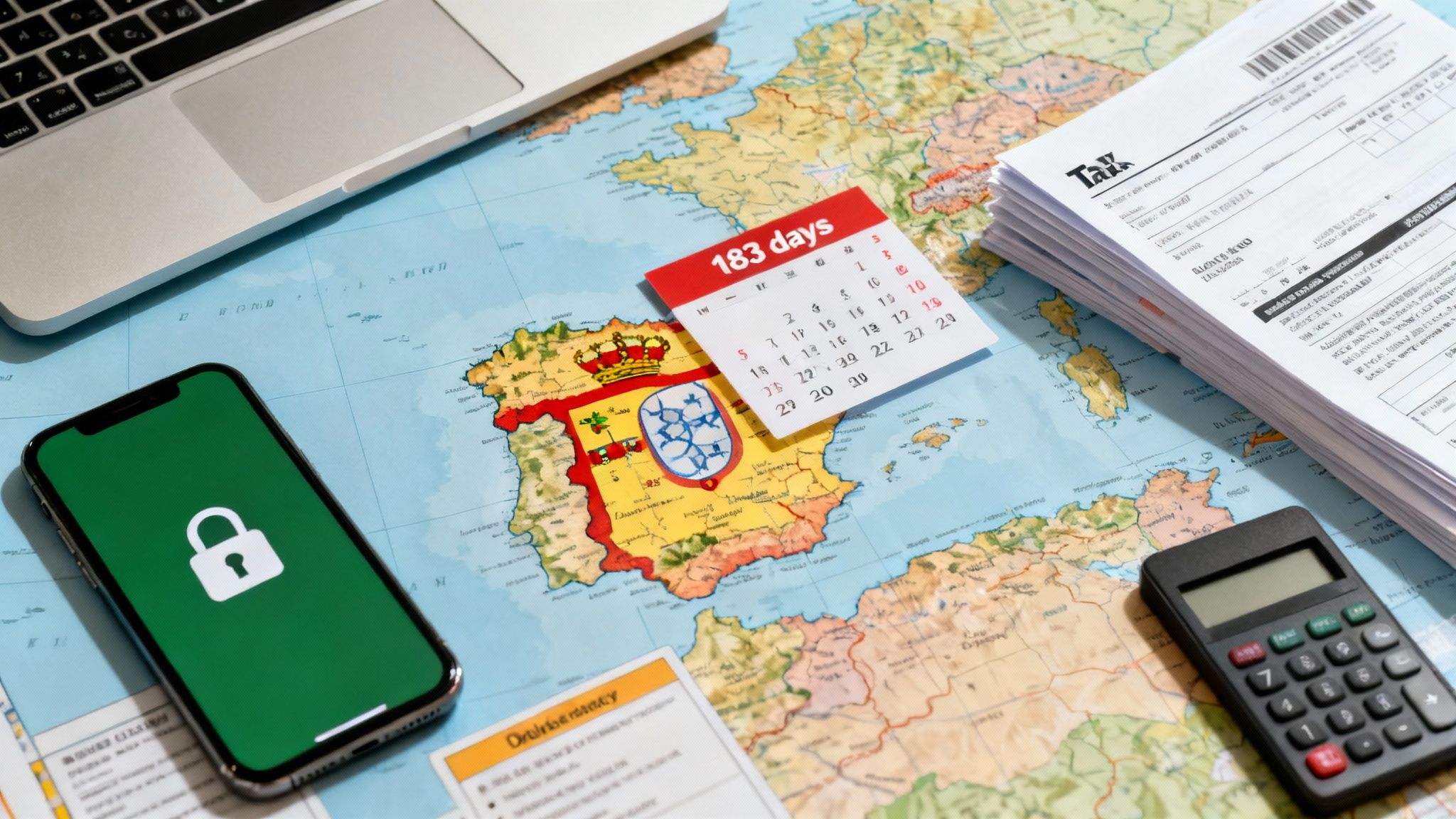
Beyond visa compliance, tracking your days is critical for managing financial and legal obligations, especially tax residency. Many countries use the 183-day rule to determine if you are a tax resident. If you spend more than 183 days in a country like Spain or Portugal in a single year, you may become liable for taxes on your worldwide income.
The burden of proof is on you. Tax authorities require a verifiable log of your time in each country. This is where the DaysAround iOS App excels as a tax residency tracker, creating a private, on-device timeline of your international movements.
- Secure and Private: Your data never leaves your iPhone. There are no cloud accounts, servers, or GPS tracking. Your travel history is yours alone.
- Automatic and Effortless: The app works in the background, using your photos to passively build your travel timeline.
- Clear Visuals: See your day counts at a glance or generate a where have I been map to visualize your global footprint.
DaysAround gives you the hard data needed to manage your tax exposure confidently, replacing guesswork with a secure, automated record.
Beyond Schengen: Other "90 Day Rules"
The "90-day rule" concept exists elsewhere. The U.S. has a 90-Day Rule in immigration law that presumes misrepresentation if a person enters on a temporary visa and then tries to adjust their status to permanent resident within 90 days. You can learn more about this rule in U.S. immigration on citizenpath.com. While different, it highlights the global importance of accurate time tracking.
For families, global travel also involves specific requirements like the Ds 3053 Child Travel Consent Form. DaysAround is more than a Schengen tracker; it’s a complete travel history app that puts you in control, helping you navigate complex international rules securely.
Frequently Asked Questions (FAQ)
1. Does time in non-Schengen EU countries count towards the 90-day limit?
No. Time spent in EU countries that are not part of the Schengen Area, such as Ireland and Cyprus, does not count against your 90-day Schengen allowance. The DaysAround iOS App automatically distinguishes between Schengen and non-Schengen countries.
2. Can I leave for a weekend to “reset” the 180-day clock?
No, this is a dangerous myth. You cannot "reset" the clock. The 90/180 rule uses a rolling timeframe that always looks back 180 days. Days are only returned to your allowance once they "age out" of this window.
3. How will the new ETIAS system change the 90-day rule?
ETIAS (European Travel Information and Authorisation System) does not change the 90/180-day rule itself. It is a pre-travel authorization system, similar to the U.S. ESTA. It will make automated tracking of entries and exits more robust, making accurate personal day counting even more critical.
4. What if I have a long-stay national visa (Type D) for one country?
A long-stay national visa allows you to remain in the issuing country for more than 90 days. It also grants you the right to travel to other Schengen countries for up to 90 days within any 180-day period. The time spent in the country that issued your visa does not count against this separate travel allowance.
5. Are my arrival and departure days counted as full days?
Yes. Both your entry day and your exit day count as full days toward your 90-day limit, regardless of the time you cross the border. The DaysAround app logs these dates precisely, eliminating guesswork.
6. Is it safe to track my travel history with an app?
It depends on the app. The DaysAround iOS App is designed for privacy. It builds your travel timeline 100% on your device without using GPS, cloud accounts, or servers. Your data never leaves your phone, making it a secure countries visited tracker.
Sources
- European Commission, Migration and Home Affairs: The official EU source for information on short-stay visa rules and the Schengen Area.
- U.S. Department of State: Offers travel advisories and explains entry requirements for U.S. citizens traveling to Europe.
- Frontex (European Border and Coast Guard Agency): Provides official data and analysis on European border management and migration trends.
Free Schengen Calculator
Track your 90/180 day limit in the Schengen Zone. Plan future trips or check your current status.