A Guide to Digital Nomad Visa Requirements Worldwide
Discover the latest digital nomad visa requirements in our complete guide. Compare countries, understand income proof, and track your stay to ensure compliance.
Digital nomad visa requirements typically revolve around four key pillars: proof of stable remote income, comprehensive health insurance, a clean criminal record, and sufficient savings. However, a critical fifth requirement is a flawless record of your travel history, which is essential for proving compliance with immigration rules, especially in regions like Europe's Schengen Area. Keeping an accurate log of your days per country is non-negotiable for a successful application.
This is where DaysAround can help right from the start. The DaysAround app builds a secure, on-device timeline of your travels across borders, using your photos to create a private and verifiable log. This record is invaluable for filling out visa forms, proving your travel history, and managing complex stay limits, ensuring your application is built on a foundation of accuracy without compromising your privacy.
Understanding the Rise of Digital Nomad Visas
The way we work has fundamentally changed, and governments are adapting. The dream of working from a laptop on a beach is now a government-approved reality. Digital nomad visas create a legal pathway for remote workers to live and work abroad for a year or more, filling the gap between short-term tourism and permanent residency. This legal status is crucial for peace of mind and staying on the right side of international law.
Unlike a standard tourist visa, which strictly forbids any kind of work, these permits are built specifically for professionals who aren't tied to a physical office. They neatly fill the gap between a short holiday and permanent residency, letting you legally live in a new country while earning your income from clients or employers back home. Getting this right is absolutely essential for staying on the right side of the law and giving you total peace of mind.
The Post-Pandemic Boom
The popularity of these visas has exploded. In a massive shift following the pandemic, a staggering 91% of all digital nomad visas worldwide were launched after 2020. It’s been a rapid wave of new policy as countries compete to attract skilled, high-earning remote talent. By 2025, 64 nations had rolled out these programs—a huge jump from just a handful before the pandemic. This boom is what shapes the common requirements you see today, as governments want to welcome new people while ensuring they won't become a financial burden.
Why Accurate Travel History Is Your Secret Weapon
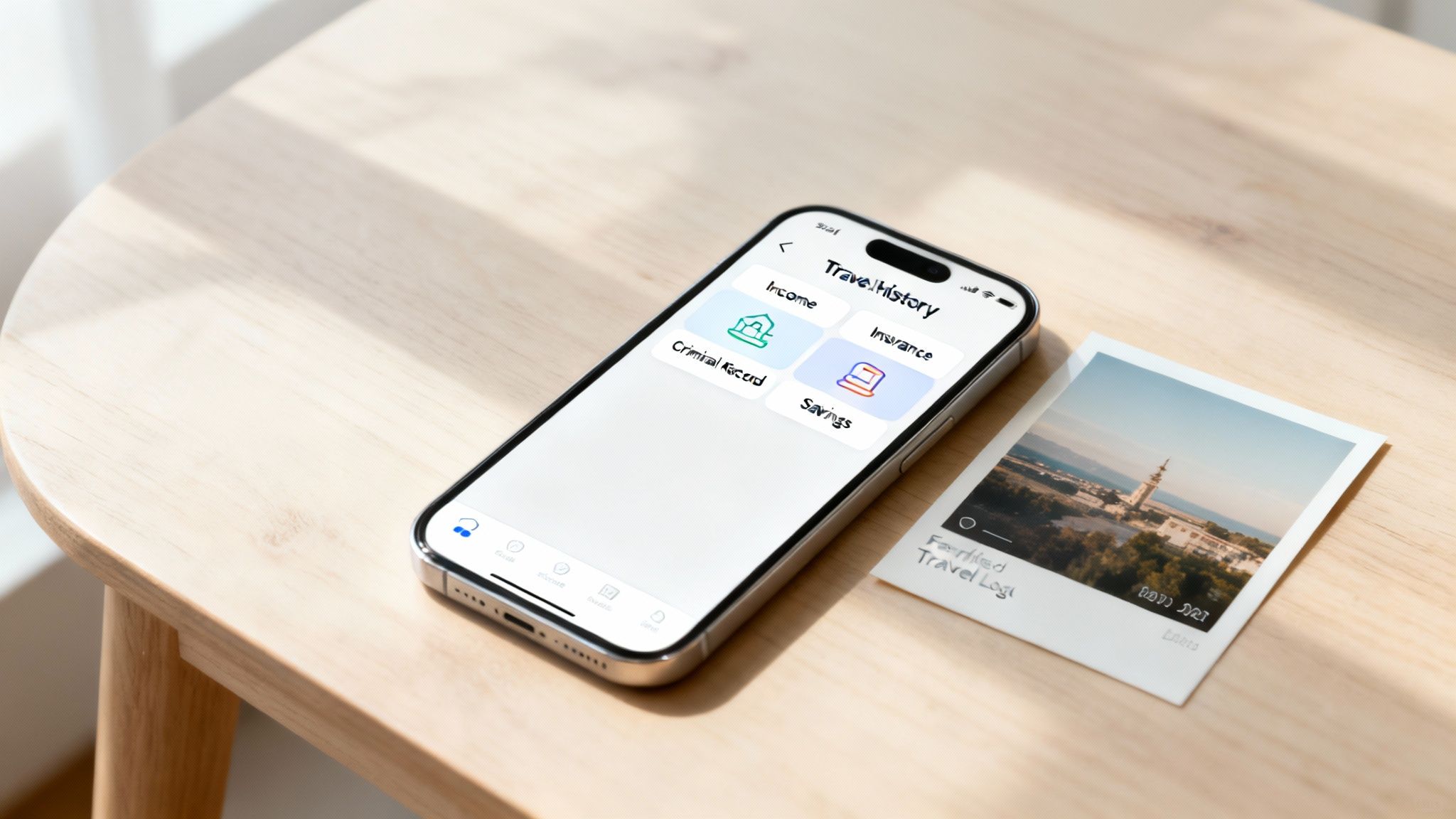
Every single visa application will ask you to list where you've been and when. Any mistake, even an honest one, can raise a red flag and lead to rejection. This is why keeping a meticulous record of your movements isn't just a good idea—it's non-negotiable.
A verifiable travel history isn't just a list of dates; it's proof of your reliability and your respect for international immigration laws. It tells officials you are a responsible global citizen.
The DaysAround app makes building this proof completely effortless. By automatically creating a timeline from your photos, it becomes your personal country counter and travel history app. You can quickly generate private travel records for visa forms or show your movement patterns if an official asks for more detail. It ensures your entire application is built on a solid foundation of accuracy, all while keeping your data private on your device.
As you explore your options, you'll find that some locations cater specifically to freelancers. For example, understanding the Freelance Visa Dubai Requirements can open up a fantastic opportunity for independent professionals looking for a new base.
The 4 Pillars of a Successful Nomad Visa Application
When you apply for a digital nomad visa, you're essentially making a case to a foreign government. You're telling them, "I'm a responsible, self-sufficient professional who can support myself while living here, and I won't be a burden on your system."
While every country has its own unique quirks, nearly every application rests on four foundational pillars. Get these right, and you're well on your way.

Think of it like building a case for a jury. Each document you submit is a piece of evidence. Your goal is to leave no room for doubt, presenting a clear, consistent, and compelling story that shows you tick every single box.
Pillar 1: Proof of Remote Income
This is the big one. It’s non-negotiable. Consulates need undeniable proof of stable, recurring income that comes from outside their country. A single screenshot of your bank balance just won't fly; they want to see a pattern of financial reliability over time.
To build a rock-solid financial case, you'll need a combination of these:
- Employment Contract: If you're an employee, this is a letter from your company confirming your remote status, role, and salary.
- Client Contracts: For freelancers, this means signed agreements outlining your work and payment terms. It shows you have ongoing projects.
- Bank Statements: This is crucial. Be prepared to provide 6 to 12 months of statements that clearly show those regular deposits from your employer or clients hitting your account.
- Tax Returns: Your most recent tax returns act as official, government-verified proof of what you've earned.
This paper trail isn't just about a number; it tells the story of your financial stability and proves you can sustain yourself for the long haul.
Pillar 2: Health Insurance Coverage
No country wants to foot the bill for a visitor's medical emergency. Period. You must prove you have a robust health insurance policy that’s valid in your destination country for the entire visa period.
Your policy needs to cover the essentials:
- Emergency medical care
- Hospitalization costs
- Repatriation (which is the cost of flying you home if a medical situation gets really serious)
Many visas, especially in the Schengen Area, get very specific, often requiring a minimum coverage amount of €30,000. Don't just buy any travel insurance; read the fine print and make sure your policy meets the consulate's exact requirements before you even think about submitting your application.
Pillar 3: A Clean Criminal Record
Governments need to know they're welcoming law-abiding people into their country. You will almost certainly need to provide a criminal background check from your home country, like an FBI Identity History Summary if you're from the US.
This isn't just a simple printout. The document itself usually needs to be legalized for international use through a process called an apostille. This is basically an official stamp that certifies its authenticity for foreign governments.
This part of the process can be tricky and full of red tape. You can find a helpful guide to translation and apostille for official documents that breaks down this often-confusing step.
Pillar 4: Sufficient Savings (Proof of Funds)
On top of your monthly income, many countries want to see that you have a financial safety net. It’s their way of making sure you can handle an unexpected expense—a sudden client loss, a laptop meltdown, or an emergency flight home—without needing local help.
The specific amount varies widely, but it’s usually a lump sum you need to show in a bank account. This reassures officials that you're not just living paycheck to paycheck and have reserves to fall back on if things go sideways.
Throughout this process, keeping meticulous records is your best friend. The DaysAround iOS App is an essential tool for this. It serves as your private travel history app, automatically logging your days per country from your photos. This creates an undeniable record of your movements, which can serve as powerful supplementary evidence to demonstrate a history of responsible global travel and add an extra layer of credibility to your profile.
Comparing Top Digital Nomad Destinations
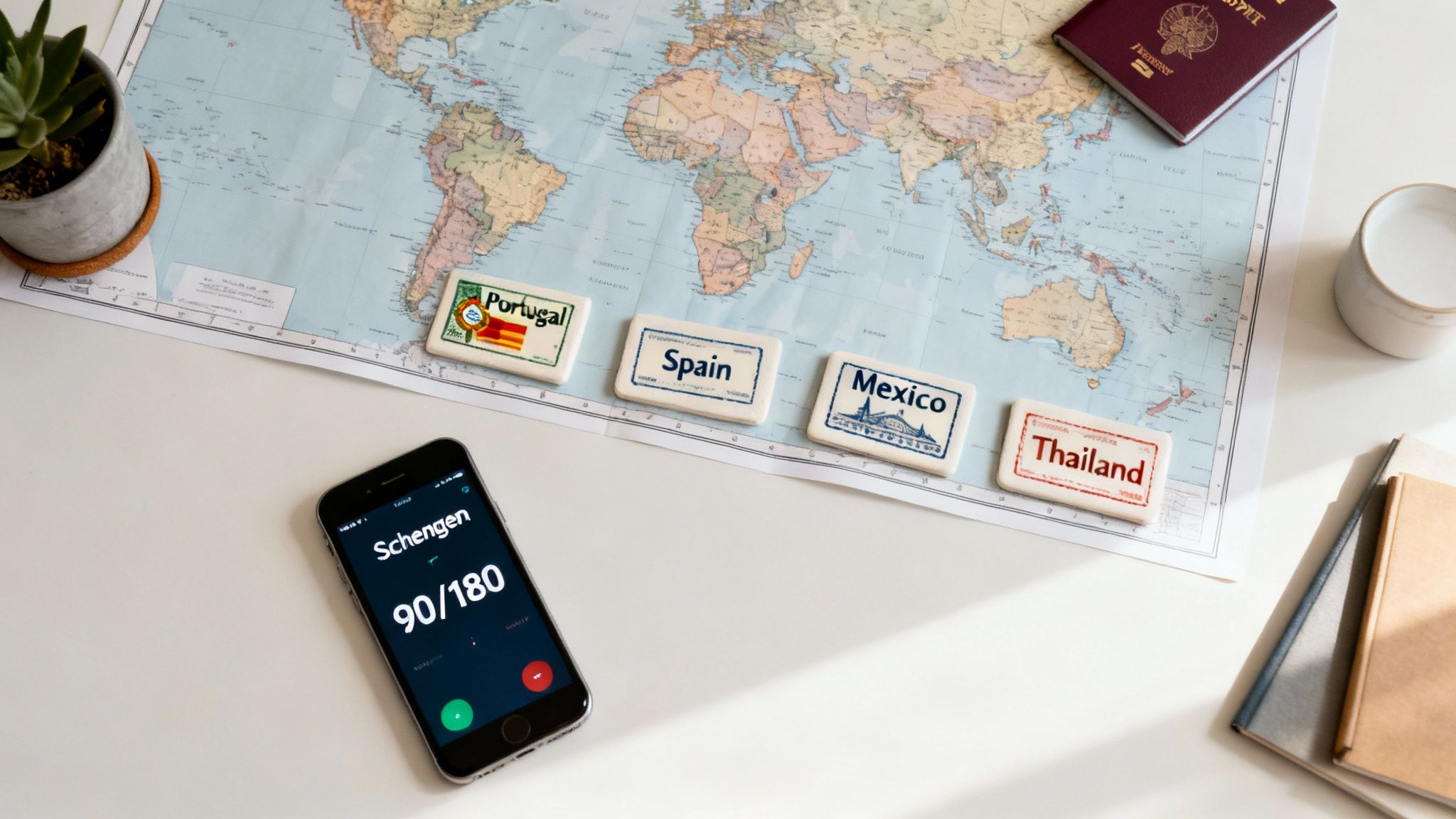
Choosing your destination is exciting, but the details in visa requirements can be tricky. With dozens of countries officially welcoming remote workers, you must look beyond the beautiful scenery and understand the fine print, especially in Europe where strict stay limits can disrupt your plans if you aren't prepared.
The number of countries offering these visas has exploded. As of 2025, there are now 64 countries with dedicated programs. The Americas lead the pack, making up 41% of the options, with Europe close behind at 31%. This boom is largely thanks to countries setting achievable income thresholds, like Brazil's $1,500/month or Mexico's €1,742, making a long-term stay a realistic goal. If you're curious, you can find more insights about the global digital nomad population.
Picking the right spot is a balancing act between your dream lifestyle and the hard reality of visa paperwork. This is where you have to put on your planning hat, especially if you’ve got your eye on more than one country.
European Hubs: Portugal and Spain
Europe is a perennial favorite for its incredible culture and quality of life. Portugal and Spain have really stepped up as frontrunners, each offering a fantastic package but with different rules that suit different kinds of nomads.
-
Portugal (D8 Digital Nomad Visa): Known for its affordable cost of living and amazing cities like Lisbon and Porto, Portugal sets the income bar at around €3,280 per month. The big win here is that it offers a clear path to residency and unlocks visa-free travel across the 29-country Schengen Area.
-
Spain (Digital Nomad Visa): Spain's visa is a bit more demanding, requiring a monthly income of about €2,520. But for higher earners, the real prize is its tax setup—a flat 24% tax rate for nomads who qualify, which can be a huge financial advantage.
When you're hopping around Europe, you have to become a master of the Schengen 90/180-day rule. Even if you have a long-stay visa for one country, your time as a tourist in other Schengen nations is still capped. A smart first move is to plan your travels with a free tool like the DaysAround Schengen Zone Calculator. For automated, private tracking, the DaysAround iOS app does the same thing automatically using your photos.
The Americas: A Mix of Easy Living and Adventure
From tropical beaches to massive cities, the Americas offer an incredible variety of options. Mexico and Costa Rica are especially popular because their application processes are straightforward and the income requirements are more relaxed.
The Americas lead the world in the sheer number of digital nomad programs available. This reflects a regional strategy to attract remote talent with competitive, accessible visa options that often feature longer stays and simpler financial proofs.
These places are perfect for nomads who want a great work-life balance without having to jump through the same hoops as in some European countries.
-
Mexico (Temporary Resident Visa): While it's not officially called a "digital nomad visa," it functions exactly like one. It's one of the most accessible out there, asking for a monthly income of roughly $2,500 or a bank balance of around $42,000. Best of all, it can be issued for up to four years, giving you incredible long-term stability.
-
Costa Rica (Digital Nomad Visa): Famous for its "Pura Vida" lifestyle, Costa Rica requires a monthly income of $3,000. The main draw? A complete exemption from local income tax on your foreign earnings, making it one of the most tax-friendly spots on the planet.
As you move between countries, keeping an accurate country counter is crucial for future visa applications and tax purposes. The DaysAround iOS app is brilliant for this because it automatically creates a private log of your stays, ensuring you always have a verifiable record of your travel history.
Asian Hotspots: Thailand and Malaysia
Asia has long been a go-to for remote workers, blending affordability with modern infrastructure. Now, countries like Thailand and Malaysia have rolled out official programs to make it even easier to stay.
These countries offer a unique mix of futuristic city life and breathtaking nature, often at a fraction of what you’d pay back home.
With so many great options, it helps to see the key details side-by-side.
Digital Nomad Visa Showdown: Europe vs. The Americas vs. Asia
Here’s a quick-glance table to help you compare some of the most popular destinations across the globe, focusing on proof of stay and residency rules.
| Country | Minimum Monthly Income (USD) | Visa Length | Key Benefit |
|---|---|---|---|
| Portugal | $3,540 | 1 year, renewable | Path to EU residency and Schengen access |
| Spain | $2,720 | 1 year, renewable | Favorable 24% flat tax rate |
| Mexico | $2,500 | Up to 4 years | Long-term stability and low income bar |
| Thailand | $2,200 (Long Term Residence) | Up to 10 years | Very long stay and low 17% tax rate |
| Malaysia | $2,000 | Up to 2 years | Low cost of living and simple application |
As you can see, the "best" visa really depends on your financial situation and long-term goals. To manage your time in these locations and generate proof of stay, the DaysAround app is invaluable. It functions as a full-blown countries visited tracker, using your photos' metadata to build a secure timeline right on your device. This creates a visual countries visited map without ever tracking your GPS or uploading your data, providing private, verifiable travel records.
Your Step-by-Step Application Workflow
Let’s be honest, tackling a visa application can feel like preparing a legal case. It’s intimidating. But if you break it down into a clear, methodical workflow, you can turn that mountain of paperwork into a series of manageable steps. Think of it less as bureaucracy and more as building a compelling story about yourself.
Accuracy is everything here. Even tiny mistakes or inconsistencies can cause frustrating delays or, worse, an outright rejection. This is particularly true when it comes to your travel history. Consulates need a perfect record of your movements, and this is where keeping your own private travel log becomes a secret weapon, ensuring what you submit is 100% correct.
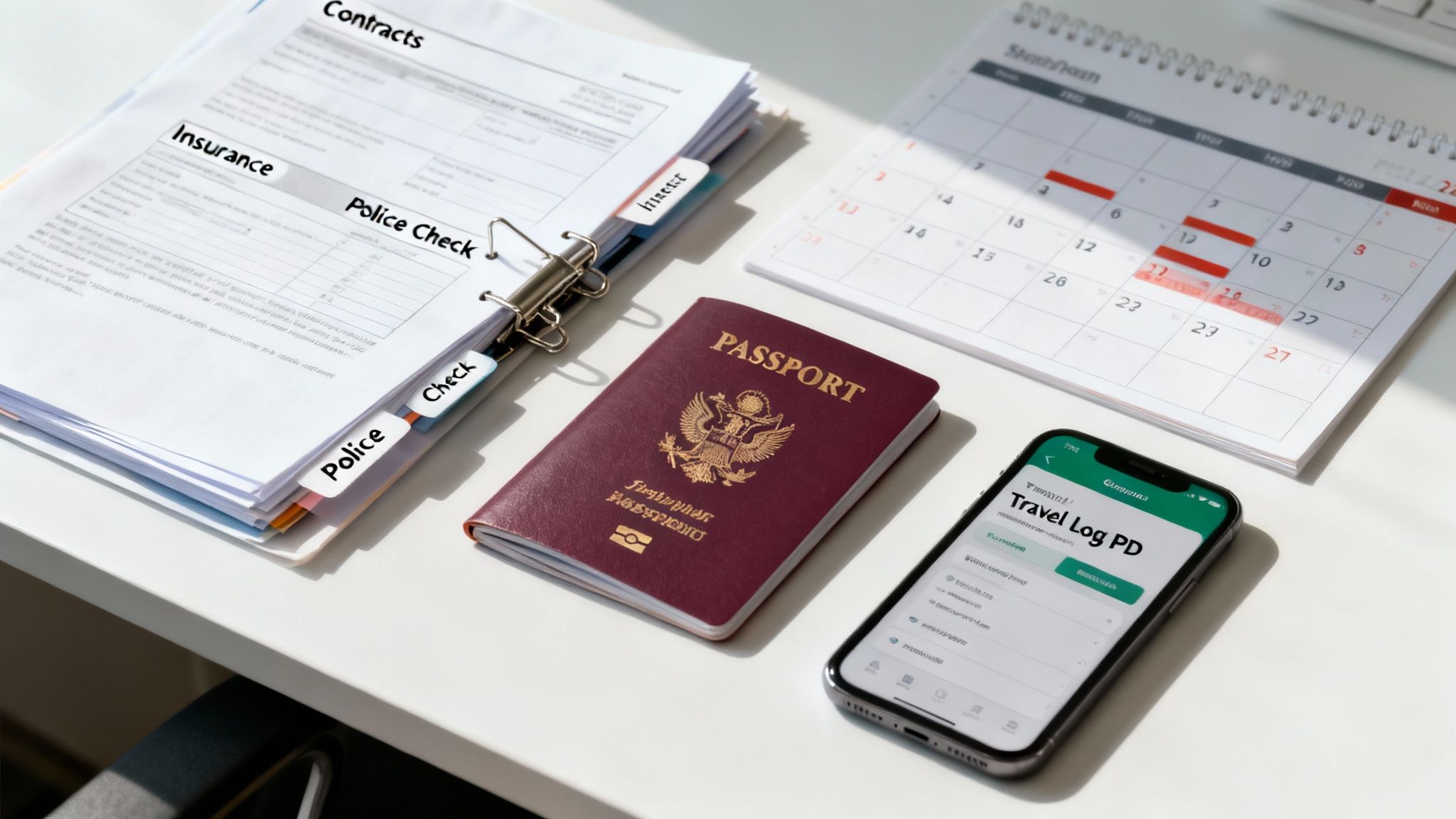
Step 1: Build Your Document Dossier
First things first: you need a master list. Head straight to the official embassy or consulate website for the country you’re targeting and print out their specific document requirements. This isn't the time for generic advice; you need the official source.
Now, start gathering your evidence. Your core file will almost certainly need:
- Passport: Make sure it’s valid for at least six months after your planned stay and has two completely blank pages.
- Application Form: Always download the latest version directly from the official government site.
- Passport-Sized Photos: Get these done professionally. They have very specific rules about size, background, and how old they can be.
- Proof of Income: This usually means 6-12 months of bank statements, signed client contracts, or a formal letter from your employer.
- Health Insurance Policy: You'll need a certificate of coverage that meets the local minimum—for instance, €30,000 is a common requirement in the Schengen Area.
- Criminal Record Check: An official background check from your home country, like an FBI report in the US.
Step 2: Legalize and Prepare Your Paperwork
Just collecting the documents is only half the battle. They need to be officially prepared for international scrutiny, a process that can take weeks, so you absolutely must factor this into your timeline.
Here’s what that typically involves:
- Apostilles: This is a fancy word for an official certification that makes a document legit in other countries. You'll likely need one for your criminal record check or birth certificate if your destination is part of the Hague Convention.
- Translations: If your documents are in English but you're applying to Spain, you'll need them translated into Spanish. And not by a friend—it has to be done by a sworn or certified translator.
- Notarizations: Some documents, like financial affidavits, might need to be signed in front of a notary public to verify your identity.
This is where the devil is truly in the details. One missing stamp or an uncertified translation can bring your entire application to a screeching halt.
Step 3: Cross-Reference Your Travel History
Okay, before you even think about filling out the travel history section on your application, it's time for an accuracy audit. This is where a tool like the DaysAround iOS app becomes your compliance partner. It works as your own private travel history app, creating a verifiable log of your past trips automatically from your photos.
Using a private, on-device tool like DaysAround to cross-reference dates ensures the information you submit is flawless. It eliminates guesswork and prevents the kind of small, unintentional errors that can undermine an otherwise perfect application.
Export the log from the app and check it against your passport stamps and your own memory. This process helps you build a bulletproof timeline, confirming every entry and exit date before you write it down on an official form. It’s a simple step, but it shows the consular officer you're meticulous and trustworthy.
Step 4: Submit and Follow Up
With your complete, double-checked, and perfectly organized dossier, you’re finally ready. Depending on the country, you might submit online, by mail, or in person at a consulate or a third-party visa center. My advice? Book any required appointment as far in advance as possible—slots can disappear months ahead.
Once you’ve submitted everything, hang on to your receipt and tracking number like they’re gold. Then, prepare to be patient. Processing can take anywhere from a few weeks to several months. By following this workflow, you can rest easy knowing you've put forward the strongest, clearest, and most credible case for your digital nomad visa.
Navigating Tax Residency and Schengen Rules
Once you have your visa, the real complexities begin. Two major hurdles can trip up even the most experienced digital nomads: figuring out tax residency and navigating the strict travel limits within Europe's Schengen Area.
Getting these wrong isn't a small mistake. It can lead to massive tax bills or even get you banned from your favorite countries. Honestly, mastering these rules is what separates a successful long-term nomad from someone who has to pack it all in after a year.
Understanding Tax Residency and the 183-Day Rule
So, what is tax residency? At its core, it's pretty simple. If you spend enough time in a country, they'll want you to pay taxes there. The most common trigger for this is the 183-day rule.
Think of it as a ticking clock. Once you spend more than 183 days—roughly six months—in a single country within their tax year, you might suddenly be on the hook to pay them taxes on your entire worldwide income. It’s a high-stakes game where staying 182 days could mean you owe nothing, but one extra weekend trip pushes you to 184 days and triggers a huge tax liability.
This is where you absolutely cannot afford to be sloppy with your record-keeping. A private tax residency tracker is a lifesaver here. The DaysAround iOS App is built for this, helping you keep a precise count of your days in every country. It can automatically build a secure timeline on your phone using your photo locations, giving you a crystal-clear record to manage your stays and avoid nasty tax surprises.
The Schengen Zone 90/180-Day Rule Explained
For anyone dreaming of bouncing between Paris, Rome, and Berlin, the Schengen Area is both a blessing and a curse. This zone of 29 European countries lets you travel freely without border checks. But for non-EU citizens, there’s a catch: the infamous 90/180-day rule.
This rule says you can only spend 90 days within the Schengen zone during any 180-day period. The key word there is "any." It's a rolling window that looks back from today, not a simple calendar reset every six months. Trying to track this on a spreadsheet is a recipe for disaster. If you want to dive deeper, we have a whole guide explaining what the Schengen 90/180 rule is and how it works.
Make no mistake: overstaying your Schengen limit, even by a single day, is a serious violation. You could face hefty fines, deportation, and a multi-year ban from ever coming back. It’s a surefire way to end your European adventures for good.
To stay on the right side of the law, a reliable Schengen calculator is non-negotiable. The free Schengen Zone Calculator from DaysAround is a fantastic tool for this, letting you plan future trips and see exactly where you stand.
Here's a peek at what our free web-based calculator looks like.
As you can see, it gives you the crucial numbers at a glance: total days used, how many you have left, and the exact date you need to leave the zone. No more guesswork.
How DaysAround Puts Your Compliance on Autopilot
While the free web tool is great for planning, the real magic happens when this tracking becomes automatic. The DaysAround iOS App takes the calculator and puts it on steroids by using your phone's photo metadata to log your entries and exits from the Schengen zone automatically. You never have to type in a single date.
It essentially becomes your personal Schengen 90/180 tracker, running quietly in the background.
- Totally Private: Your travel history is never uploaded to a server or tracked via GPS. It lives only on your phone, period.
- Automatic Math: The app handles all the complex rolling-window calculations, giving you a simple, visual countdown of your remaining Schengen days.
- Effortless Proof: It creates a detailed travel history app that you can use as powerful evidence if a border official ever questions your movements.
By automating this tedious but critical task, DaysAround lets you focus on actually enjoying your travels, giving you the peace of mind that you're playing by the rules.
Frequently Asked Questions (FAQ)
Stepping into the world of digital nomad visas can feel like navigating a maze. You’re not alone. Here are some straightforward answers to the questions we hear most often.
Can I Apply for a Digital Nomad Visa While I’m Already in the Country?
This is a big one, and the answer is: it depends. A few countries, like Spain, are pretty flexible and might let you switch from a tourist visa to a nomad visa without leaving. It’s a huge convenience.
But don't assume that's the norm. The vast majority of countries will send you packing, requiring you to apply from your home country or wherever you're a legal resident. Always, always check the official consulate website for the latest rules before you book a flight. It's a classic rookie mistake that can cost you a lot of time and money.
What’s the Number One Reason Applications Get Denied?
It almost always comes down to two things: money and paperwork. The most common rejection reason is failing to prove you meet the minimum income threshold. Consulates need to see clear, consistent, and well-documented proof that you can support yourself.
Right behind that is incomplete or incorrectly prepared documents. Think missing official translations, forgetting an apostille, or submitting proof of health insurance that doesn't meet their specific coverage requirements. Your best defense is a detailed checklist and a healthy dose of paranoia when double-checking your work.
How Can Freelancers Actually Prove They Work Remotely?
If you're a freelancer, you have to work a little harder to paint a clear picture of a stable, ongoing business. Vague statements won’t cut it; you need to build a solid case with hard evidence.
Pull together a package that includes:
- Client Contracts or Agreements: Get letters from your main clients that outline what you do for them and how much they pay you.
- Bank Statements: Show 6-12 months of bank statements that clearly link deposits to the clients you've listed. Consistency is key here.
- A Letter from Your Accountant: Having a certified accountant write a letter confirming your self-employment status and annual income adds a ton of credibility to your application.
Will I Have to Pay Taxes in the Country I Move To?
Ah, the million-dollar question. Tax rules are probably the trickiest part of this whole lifestyle. While some nomad visas come with tax breaks, a very common rule of thumb is the 183-day rule. If you stay in a country for more than 183 days in a year, you often become a tax resident, which could mean you owe them taxes on your global income.
Don't try to figure this out on your own. Seriously. Talk to a tax advisor who specializes in expat and international tax law. They can save you from a world of headaches and help you avoid getting taxed twice. Using a tax residency tracker, like the one inside the DaysAround app, is also a smart way to keep tabs on your physical presence.
Does a Nomad Visa Let Me Travel Freely Around Europe’s Schengen Area?
Yes, with a big asterisk. If your nomad visa is from a Schengen country (like Portugal or Germany), it acts like a residency permit. This means you can live in that country and travel to all the other Schengen countries for up to 90 days within any 180-day period.
The key thing to remember is that the time you spend in your host country doesn't eat into that 90-day travel allowance. This is exactly why a tool like the DaysAround Schengen Zone Calculator is so essential—it helps you precisely track your "tourist" days so you don't accidentally overstay your welcome elsewhere in the zone.
How Far in Advance Should I Really Start My Application?
Give yourself a runway of at least 3-6 months before you plan to leave. This isn't something you can rush.
Certain documents, especially federal background checks, can take weeks or even months to process. Then you have to factor in the time for getting documents apostilled, professionally translated, and finally, snagging an appointment at the consulate. Starting early is the single best thing you can do to make the process less stressful.
Ready to stop guessing and start tracking? DaysAround is the tool every digital nomad needs. It automatically builds a private timeline of your travel on your device, works as a bulletproof Schengen calculator, and helps you create a perfect countries visited map. Download the DaysAround iOS App today and travel with total peace of mind.
Sources
- Digital Nomad Visas: The Complete Guide (2024), Citizen Remote.
- Countries With Digital Nomad Visas, Nomad Girl.
- The Digital Nomad Index, Circleloop.
Free Schengen Calculator
Track your 90/180 day limit in the Schengen Zone. Plan future trips or check your current status.