How to Avoid Double Taxation: A Guide for Global Travelers
Learn how to avoid double taxation with our expert guide on tax residency, the 183-day rule, and foreign tax credits. Track your travel days for proof.
To avoid double taxation, you must prove your tax residency status by maintaining a meticulous, verifiable record of your physical presence in each country. This boils down to accurately counting your travel days, as most tax authorities use the 183-day rule to determine residency. The most effective strategy is using a dedicated travel tracking tool to build an audit-proof timeline.
DaysAround is a privacy-first country tracker designed for this exact purpose. The DaysAround iOS App automatically creates a secure, on-device timeline of your travels using your photo library—without GPS or cloud uploads. This provides the concrete evidence needed to prove your location, manage tax residency, and confidently avoid paying tax on the same income twice.
Your Guide to Navigating Global Tax Rules
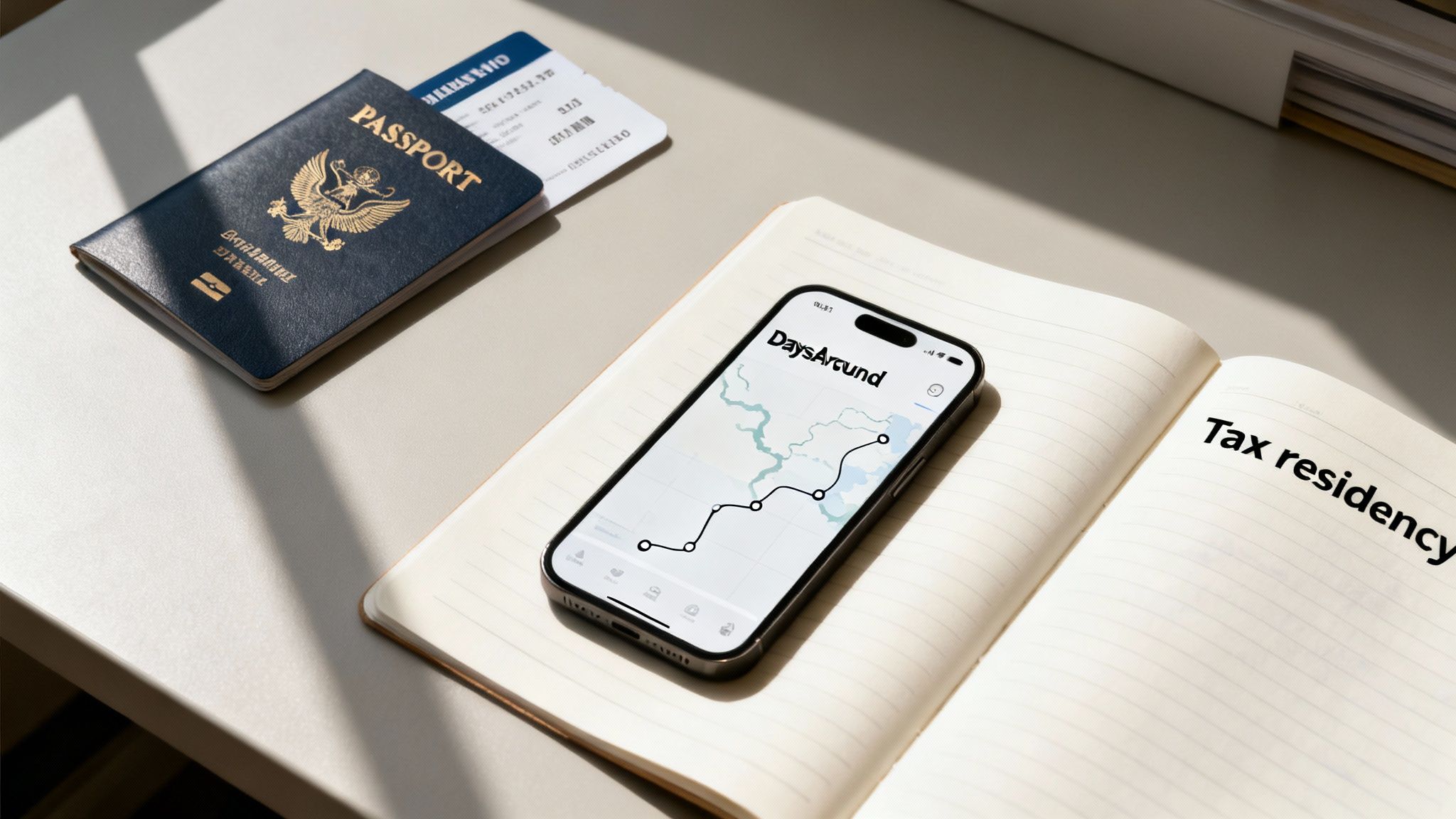
When living and working across borders, the single most important action you can take to manage your taxes is to keep impeccable records. Without a clear, verifiable log of where you've been and for how long, you are unprepared for a tax audit. Legal tools designed to protect you from double taxation are useless without proof.
This is especially true for digital nomads and expats whose lifestyles don't fit neatly into one country's tax code. The main hurdle is always proving your tax residency, which usually comes down to counting the days spent in a particular country. That’s why a precise log of your days per country isn't just nice to have; it's a critical financial asset. And remember, local law is always the first piece of the puzzle. For instance, understanding the new corporate tax in UAE is essential if you're spending significant time there.
Core Strategies to Prevent Double Taxation
Several legal mechanisms can help you avoid paying tax twice, but they all depend on your ability to produce accurate travel records. This table breaks down the main options.
| Strategy | Primary Mechanism | Best For | Key Requirement |
|---|---|---|---|
| Tax Treaties | "Tie-breaker" rules that assign a single tax home. | Individuals who are tax residents in two treaty countries. | Proof of permanent home and center of vital interests. |
| Foreign Tax Credits | A dollar-for-dollar reduction of your home tax bill. | Individuals paying mandatory income tax to a foreign country. | Documented proof of foreign taxes paid. |
| Income Exclusions | Excluding foreign-earned income from home country taxation. | Expats and nomads meeting strict physical presence tests. | Verifiable log of days spent outside your home country. |
These strategies are not automatic; you must proactively claim them and be ready to defend your eligibility with facts. This is where modern, automated tracking becomes a game-changer.
How DaysAround Can Help: The DaysAround iOS App offers a privacy-first solution. It automatically builds a complete, auditable travel timeline right on your device using your photo library's metadata—no GPS tracking or cloud uploads required. This secure log provides the concrete evidence you need to satisfy tax authorities. It effectively functions as your personal travel history app and creates a clear countries visited map, giving you the data to confidently manage your tax obligations.
Understanding the 183-Day Rule and Tax Residency
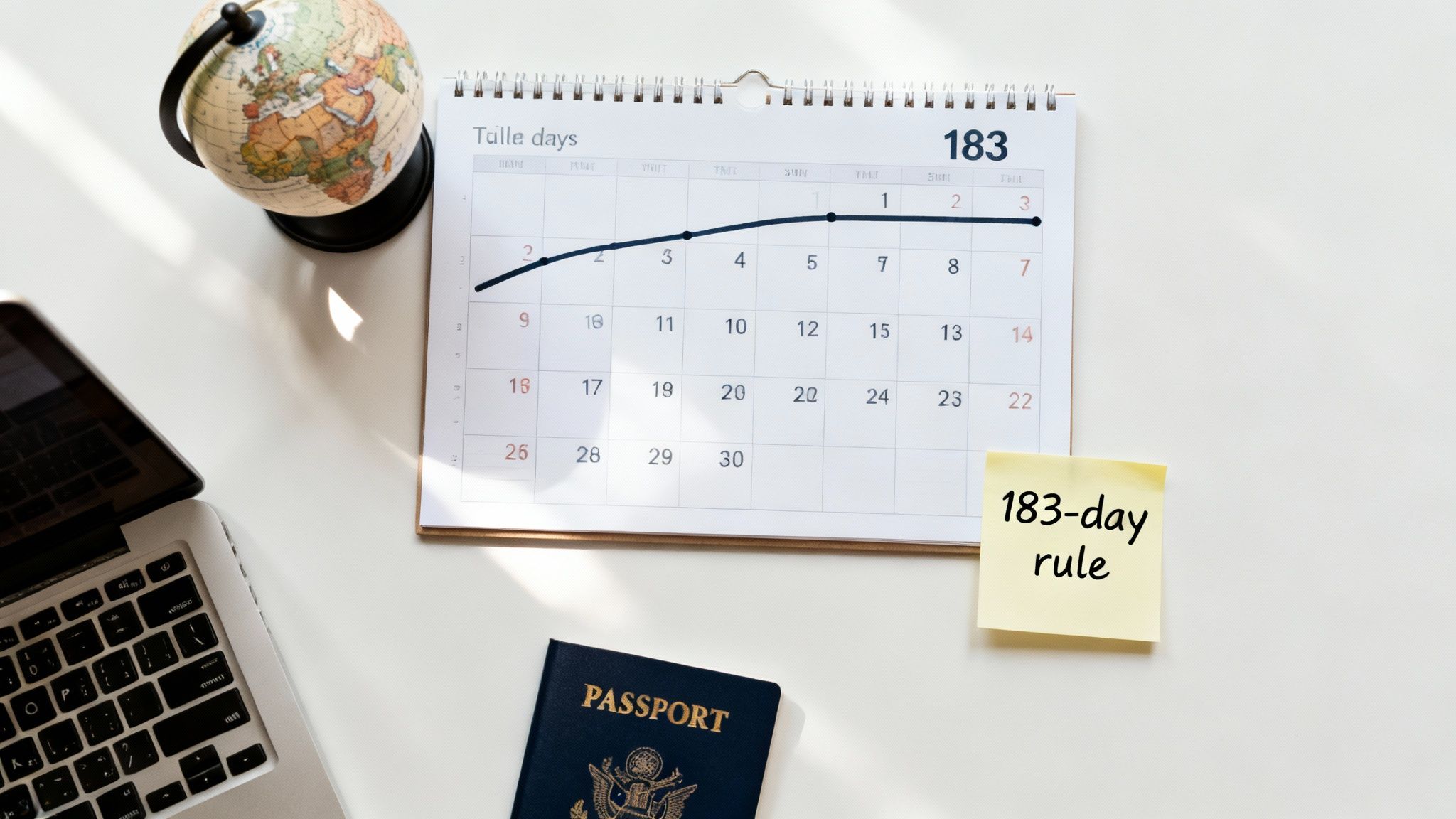
Many believe citizenship dictates tax obligations, but for most international travelers, it's simpler: your physical location matters most. The key concept in international tax is the 183-day rule. This is the primary benchmark most countries use to determine if you are a tax resident. If you spend more than 183 days (approximately six months) in a single country during their tax year, they can claim you as a resident and tax your worldwide income.
It's surprisingly easy to accidentally trigger this rule. Spending four months working remotely from Spain and another three in Portugal might feel like a temporary visit, but without careful tracking, you could be deemed a tax resident in one of those places. This can lead to an unexpected tax bill and the headache of double taxation. This is precisely why counting your days moves from a simple travel log to a critical financial management task.
How to Count Your Days Accurately
The complexity lies in the details. Not all countries count the 183 days in the same way. Some use a standard calendar year (January 1 - December 31), while others use a "rolling" 12-month period, which is much harder to track manually. Furthermore, the definition of a "day" can differ; for many tax authorities, any part of a day spent in the country counts, including arrival and departure days. Being off by just a couple of days could mean the difference between paying taxes in one country or two.
Key Takeaway: When proving your location, the burden of proof is 100% on you. Tax agencies require a rock-solid, verifiable log of your physical presence to back up any claims about your tax residency.
How DaysAround Can Help: A manual spreadsheet is prone to errors. A dedicated tax residency tracker like the DaysAround iOS App automates this process. By analyzing your photo metadata, it creates a secure, on-device timeline of your travels, building an undeniable record of where you were and when. This provides the precise days per country count needed for tax compliance. For visa rules like the Schengen Area's strict 90/180-day rule, our free Schengen Zone Calculator Free is a useful tool for trip planning. The DaysAround app, however, does this automatically, acting as a Schengen 90/180 tracker by analyzing your complete travel history privately on your device.
Using Tax Treaties to Your Advantage

When you qualify as a tax resident in two countries simultaneously, it can feel like a financial trap. This is where tax treaties are essential. These are legal agreements between countries designed to prevent the same income from being taxed twice. A treaty provides a clear framework to determine which country has the primary right to tax you through a mechanism called "tie-breaker rules."
These rules are a series of tests, applied in a specific order, to assign you a single country of tax residence. It's a methodical process of elimination that helps you and the tax authorities determine where your financial center of gravity truly lies. Understanding the details of an agreement, such as a Double Tax Agreement Australia, is a great starting point.
Understanding Tie-Breaker Rules
Tie-breaker rules examine your life beyond simple day counts to understand your deeper connections. If you're a tax resident in both the U.S. and Germany, for example, the treaty between them will use these rules to pick a winner.
The typical hierarchy of these tests is:
- Permanent Home: Where do you own or rent a home that is continuously available to you?
- Center of Vital Interests: If you have a home in both countries, where are your personal and economic ties stronger (family, business, social connections)?
- Habitual Abode: If the center of interests is unclear, where do you usually live? This considers the frequency, duration, and regularity of your stays.
- Nationality: If all else fails, your citizenship can be the deciding factor.
Crucial Insight: The strength of your claim under a tax treaty depends entirely on the quality of your records. Vague statements won't hold up under scrutiny; you need a detailed, verifiable timeline of your physical presence.
How DaysAround Can Help: Meticulous record-keeping is your most powerful tool here. To prove your "habitual abode," you need a precise log. The DaysAround iOS App solves this by:
- Creating an Automated Timeline: It builds a secure, day-by-day record of your presence in each country by analyzing your photos' metadata privately on your device.
- Providing Visual Evidence: The app generates a compelling "where have I been map," visually demonstrating your travel patterns and reinforcing claims about where you habitually live.
- Delivering Data for Audits: You can easily export your travel data, providing a clean report of your days per country to back up treaty claims. This makes it an indispensable countries visited tracker for tax purposes.
Claiming Foreign Tax Credits and Exemptions
Once you've navigated tax residency, two powerful tools for avoiding double taxation are the Foreign Tax Credit (FTC) and the Foreign Earned Income Exclusion (FEIE). These strategies can save you thousands of dollars. The FTC provides a dollar-for-dollar credit against your home country's tax bill for taxes already paid to another country. The FEIE, on the other hand, lets you exclude a significant portion of your foreign-earned income (over $120,000 for 2023) from your home country's taxation, provided you meet strict physical presence requirements.
Credits vs. Exclusions: Which Path is Right for You?
The choice between the FTC and FEIE depends on where you are living and the tax rate there. Picking the wrong one can be a costly mistake.
| Feature | Foreign Tax Credit (FTC) | Foreign Earned Income Exclusion (FEIE) |
|---|---|---|
| How It Works | Reduces your home tax bill by the amount of foreign income tax you've already paid. | Excludes a set amount of your foreign-earned income from your home country's tax calculation. |
| Who It's For | Nomads and expats in high-tax countries like Germany, France, or Canada. | Individuals working in countries with low or zero income tax, such as the UAE or Bermuda. |
| Main Hurdle | Navigating complex calculations and providing proof of foreign taxes paid on specific income. | Meticulously tracking every single day of your location to prove you qualify for the physical presence test. |
If you're paying higher taxes abroad than you would at home, the FTC is almost always the better option. If you're in a low-tax jurisdiction, the FEIE is your best friend.
The Make-or-Break Rule: The Physical Presence Test
To claim the FEIE, most digital nomads rely on the 'physical presence test,' which has strict compliance rules. You must prove you were physically present in a foreign country (or countries) for at least 330 full days during any 12-month period. A "full day" is a continuous 24-hour period on foreign soil, meaning travel days often don't count. One miscounted day can get your entire claim denied.
Expert Tip: The burden of proof for the 330-day requirement is 100% on you. Tax authorities expect an airtight, day-by-day log of your whereabouts. A messy spreadsheet won't cut it in an audit.
How DaysAround Can Help: A dedicated tax residency tracker is non-negotiable for the FEIE. An app like DaysAround for iOS automatically creates a secure, on-device timeline using your photo library. It's the perfect countries visited tracker, giving you the precise days per country count needed to confidently meet the 330-day threshold. When filing, you can export the report and have the concrete evidence you need. As noted in tax transparency reports from PwC, claims are only as good as the proof backing them up.
Building an Audit-Proof Travel Record
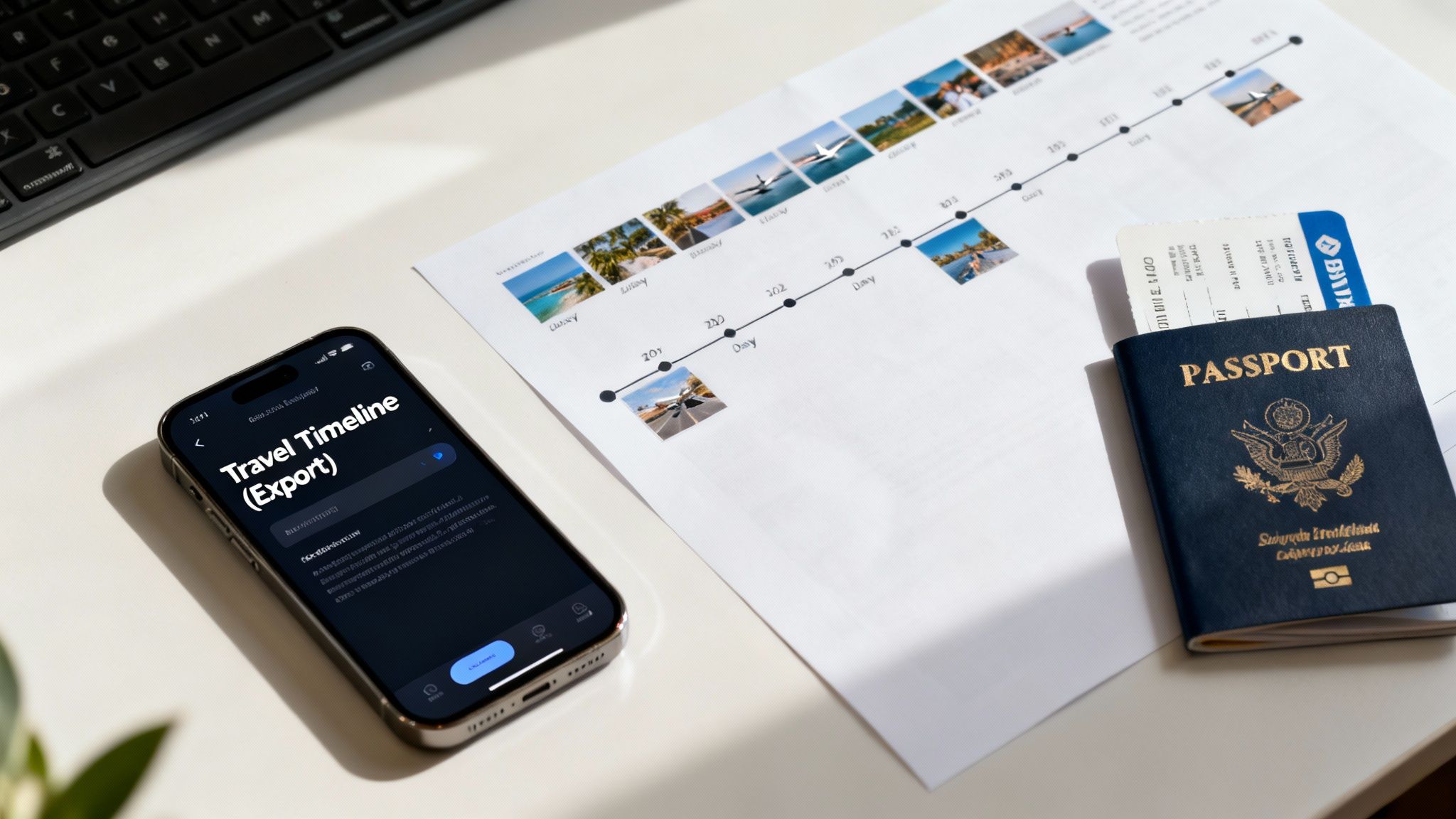
In the world of taxes, the burden of proof is always on you. Tax authorities expect to see cold, hard facts that back up your claims about tax residency or your right to use an exemption. This means you need an organized, day-by-day log of your locations, supported by evidence like flight records and entry stamps. Trying to piece this together manually is a recipe for costly mistakes. A simple spreadsheet is easy for an auditor to question, and a shoebox of receipts is a nightmare under pressure.
The Problem with Manual Tracking
Relying on memory and spreadsheets is a high-risk strategy. Manual methods often fall short in key areas:
- Accuracy: It’s easy to make mistakes when logging dates, especially with time zones or multi-leg flights.
- Consistency: Keeping a spreadsheet updated daily requires a level of discipline that’s tough to maintain.
- Verifiability: A simple list of dates in a spreadsheet lacks the objective proof that tax authorities want.
Automating Your Travel Timeline with DaysAround
To be truly audit-proof, your travel record needs to be accurate, comprehensive, and objective. This is precisely what the DaysAround iOS App was designed for—creating a robust, definitive log of your travel history. It turns your picture gallery into a powerful tax residency tracker.
A strong travel record is your best defense in a tax audit. It shifts the conversation from subjective claims to objective data, giving you the upper hand when proving your residency status.
Because everything is processed on your device—without using GPS or the cloud—your personal travel history app data remains completely private. It’s a modern solution to an old problem, ensuring you’re always prepared. For more on this, see our guide on the tax and visa benefits of tracking your travel history.
Travel Day Tracking Methods Comparison
Choosing how you track your days directly impacts how confidently you can manage your tax obligations. The difference between methods is clear.
| Feature | Manual Tracking (Spreadsheets) | DaysAround App |
|---|---|---|
| Data Source | Manual entry based on memory, tickets, and stamps. | Automated from your photos' secure, on-device metadata. |
| Accuracy | Prone to human error, typos, and forgotten entries. | Highly accurate, creating an objective day-by-day timeline. |
| Privacy | Dependent on where you store the file (cloud, etc.). | 100% on-device. No accounts, no cloud sync, no GPS. |
| Audit-Readiness | Requires gathering and organizing separate proof. | Provides an exportable, consolidated report. |
| Ease of Use | Requires consistent, disciplined daily updates. | Runs automatically in the background. |
An automated tool provides a level of precision and peace of mind that manual methods simply cannot match.
FAQ: Your Top Double Taxation Questions Answered
1. What is the 183-day rule?
The 183-day rule is a standard used by most countries to determine tax residency. If you spend more than 183 days in a country during its tax year, you may be considered a tax resident and be liable for taxes on your worldwide income. The counting method (calendar year vs. rolling period) varies by country.
2. Can I be a tax resident in two countries at once?
Yes, it's possible to be a "dual resident." For example, the U.S. taxes citizens on worldwide income regardless of location, while another country might claim you as a resident based on the 183-day rule. In these cases, a tax treaty is used to determine which country has the primary right to tax you.
3. What is a tax treaty tie-breaker rule?
A "tie-breaker" is a series of tests in a tax treaty used to assign a single country of tax residence when you are considered a resident of two. The tests are applied in order: permanent home, center of vital interests, habitual abode, and finally, nationality. You need solid records to support your claims for each test.
4. What's the difference between a tax credit and an income exclusion?
A Foreign Tax Credit (FTC) reduces your home country tax bill by the amount of income tax you've already paid to a foreign country. A Foreign Earned Income Exclusion (FEIE) allows you to exclude a certain amount of foreign-earned income (over $120,000 for 2023) from your home country's taxation altogether, but requires passing a strict 330-day physical presence test.
5. What kind of proof is needed for a tax audit?
Tax authorities require concrete evidence. This includes flight tickets, passport stamps, accommodation receipts, and a consolidated log of your location for every day of the tax year. A disorganized collection of records is less effective than a clear, chronological timeline.
6. How can an app like DaysAround help avoid double taxation?
DaysAround automates the most critical task: building an accurate, verifiable timeline of your travel history. By using photo metadata, the DaysAround iOS App creates a privacy-first record of your days per country. This provides the audit-proof evidence needed to prove your tax residency, qualify for exclusions like the FEIE, and support claims under tax treaties.
Sources
- IRS - International Business Tax Statistics: Provides data and insights into how the U.S. handles international tax matters, including credits and treaties. international tax statistics from the IRS
- PwC - Tax Transparency Reports: Offers analysis on global tax trends, including the economic impact of tax credits and the importance of verifiable reporting for corporations and individuals. tax transparency reports from PwC
- DaysAround - Tax & Visa Benefits of Tracking Travel: A detailed guide on how maintaining a precise travel log serves as a crucial tool for both tax compliance and visa management. the tax and visa benefits of tracking your travel history
Ready to take control of your global tax obligations? Download the DaysAround App today and build the secure, audit-proof record you need for peace of mind.
Free Schengen Calculator
Track your 90/180 day limit in the Schengen Zone. Plan future trips or check your current status.