The Ultimate Travel Checklist for Europe: 10 Critical Steps for 2026
Planning a trip? Our ultimate travel checklist for Europe covers visas, Schengen rules, and packing essentials to ensure a seamless journey. Start here.
Creating the perfect travel checklist for Europe involves more than just packing the right clothes; it requires a strategic approach to navigating complex visa rules, managing multi-country logistics, and ensuring your documentation is flawless for a seamless journey. The most significant challenge for modern travelers is accurately tracking days to comply with the Schengen Zone's strict 90/180-day rule. A simple miscalculation can lead to fines, future travel bans, or disruptions to your carefully planned itinerary. This guide provides a detailed blueprint covering ten essential pre-trip checklist items, explaining not just what to do, but how a tool like DaysAround can streamline the process.
From the moment you start planning, the Days Around iOS app can serve as your core compliance tool. It works by automatically and privately building a secure, on-device timeline of your travels by using the metadata from your phone's photos. Because it requires no GPS or cloud connection, your travel history remains entirely yours, making it the ultimate privacy-first tool for monitoring your Schengen stay, creating a map of countries visited, and tracking days for tax residency purposes. For manual planning, you can also use our free Days Around Schengen Calculator.
1. Obtain/Renew Your Passport and Check Expiration Dates
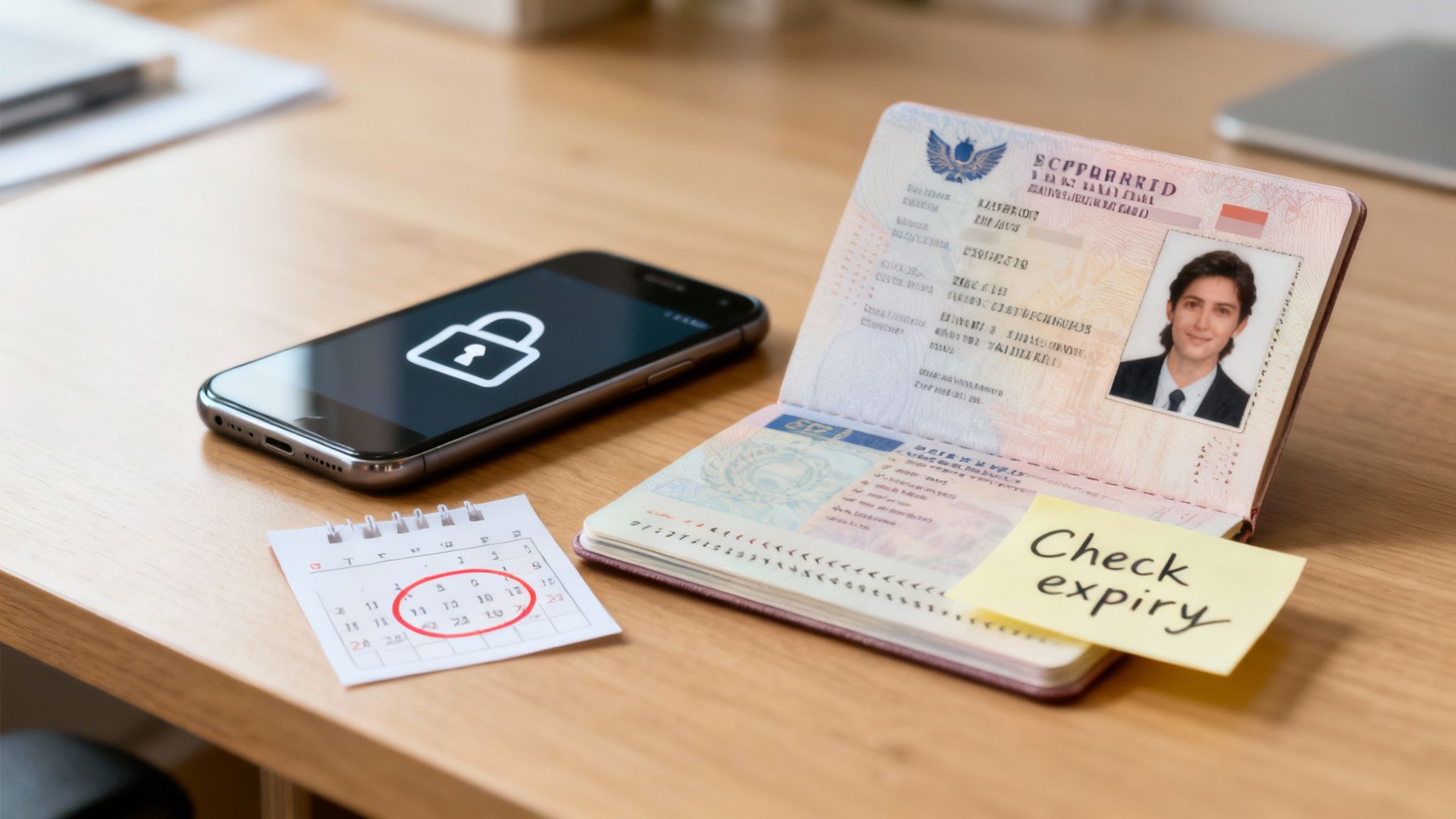
Before anything else on your travel checklist for Europe, your passport is the non-negotiable first step. Most European countries, particularly those within the Schengen Zone, have strict validity requirements. Neglecting its status can stop your trip before it begins. A common requirement is the "six-month validity rule," meaning your passport must be valid for at least six months beyond your planned departure date from the Schengen Area.
Why Passport Validity is Crucial for Europe
- Entry Requirement: Many countries will deny entry if your passport doesn't meet the six-month rule.
- Airline Compliance: Airlines will deny boarding if your passport is not valid for your destination, resulting in a canceled trip.
- Visa Applications: Valid passports are required for any visa applications you might need.
How DaysAround Can Help
For long-term travelers, passport stamps are critical data points for tracking your travel history and managing Schengen limits. The Days Around iOS app offers a privacy-first solution by automatically scanning your photos to detect border crossings and entry/exit stamps. It builds a secure, on-device timeline of your movements, allowing you to cross-reference your physical passport stamps with a digital record without relying on invasive GPS or cloud services.
Actionable Tip: Six months before any international travel, set a calendar reminder to check your passport's expiration date. If it's cutting it close, begin the renewal process immediately.
2. Research and Book Accommodations
Strategic accommodation booking is a critical component of a travel checklist for Europe because it directly impacts tax residency and visa compliance. Your lodging choices and their durations create a paper trail that authorities can use to determine your legal and financial obligations in a country, especially concerning the "183-day rule" for tax residency.

Why Strategic Booking Matters for Compliance
- Tax Residency: Many European countries use a "183-day rule" to determine tax residency. Exceeding this can trigger tax liabilities.
- Visa Compliance: Proof of accommodation is often required for visa applications and can be requested at border control.
- Schengen Rule: Your booking timeline must align with the 90/180-day rule to avoid overstays.
How DaysAround Can Help
Digital tools are invaluable for cross-referencing your accommodation plans with your actual travel history. By using the Days Around iOS app to automatically log entry and exit dates from photos of passport stamps, you can verify your physical presence against your booking confirmations. This creates an accurate, on-device country counter that aligns with your documented accommodation history, providing robust evidence for tax or visa purposes.
Actionable Tip: Always book accommodations that provide official invoices or confirmations showing your name, address, and dates of stay. Keep these digital documents in a dedicated folder.
3. Understand the Schengen Zone 90/180-Day Rule
Navigating the Schengen Area, which includes 29 European countries with open internal borders, requires careful planning. A critical component of any travel checklist for Europe is understanding the 90/180-day rule. This regulation permits visa-free travel for up to 90 days within any 180-day period.

Why the 90/180-Day Rule is Tricky
The challenge lies in the "rolling" nature of the 180-day window. It looks back 180 days from your current date to count how many days you have spent inside the zone. Miscalculating this can lead to an accidental overstay, resulting in fines, deportation, or a multi-year ban.
How DaysAround Can Help
Manually calculating your stay can be confusing. For a quick check before a trip, the free Days Around Schengen Calculator is an excellent resource. For ongoing, automated management, the Days Around iOS app provides a comprehensive solution. It uses photos on your iPhone to privately and automatically build a travel timeline, including your Schengen Zone entries and exits. The app then calculates your remaining days, giving you a clear, visual representation of your 90/180-day compliance without any manual data entry or invasive GPS tracking.
Actionable Tip: Before each entry into the Schengen Zone, use a calculator to verify your remaining allowance. Plan your exit routes at least 60 days in advance to avoid last-minute scrambles.
4. Arrange Appropriate Travel Insurance
Securing the right travel insurance is a critical but often overlooked part of any travel checklist for Europe. This coverage is your financial safety net against unforeseen events like medical emergencies, trip cancellations, or lost luggage. Medical costs can vary dramatically across Europe, making comprehensive health coverage a necessity.
Why Comprehensive Coverage is Non-Negotiable
- Medical Emergencies: A minor accident or illness abroad can quickly escalate into a significant financial burden without a proper policy.
- Visa Requirement: Private insurance is often a mandatory requirement for Schengen visa applications.
- Trip Protection: Covers cancellations, interruptions, and lost luggage.
- For those planning longer stays or wanting comprehensive protection during your trip to Europe, it's essential to consider robust options for international health insurance.
How DaysAround Can Help
For travelers moving between multiple European countries, aligning your insurance policy with your actual location is vital. Many multi-country policies require you to track your days spent in each nation. The Days Around iOS app simplifies this by creating a private, on-device timeline of your movements. Should you need to file a claim, you can use the app's timestamped photo timeline to prove your location at the time of the incident, strengthening your case with your insurer.
Actionable Tip: Always purchase travel insurance before your departure. Declare all pre-existing medical conditions to avoid having a claim denied.
5. Check Visa Requirements for Your Nationality
After confirming your passport's validity, the next critical step on your travel checklist for Europe is verifying visa requirements. This process is highly dependent on your nationality and your intended route. A visa for one country doesn't guarantee entry into another, especially for nations outside the Schengen agreement.
Why Visa Planning is Essential for Multi-Country Trips
- Legal Entry: Overlooking visa requirements can halt your travel plans abruptly.
- Route Planning: Strategic route planning based on visa allowances is crucial for maintaining legal status.
- Documentation: Some nations may require professional immigration document translation for supporting documents.
How DaysAround Can Help
Accurate documentation of your travel dates is non-negotiable when dealing with visa limitations. Authorities may require a detailed travel history, and having a precise record is essential. The Days Around iOS app provides a robust, privacy-focused tool for this. By automatically detecting and logging your border crossings from your photo library, it creates an on-device timeline of your movements. You can export this data to demonstrate a legitimate travel history for new visa applications or to prove adherence to visa stay limits.
Actionable Tip: Use official embassy websites to confirm requirements for every country on your itinerary at least three months before your trip.
6. Arrange Transportation (Flights, Trains, Local Transit)
Securing your transportation is a crucial step in your travel checklist for Europe, dictating your budget and the flow of your itinerary. Europe’s extensive network of low-cost airlines, high-speed trains, and buses offers incredible flexibility, but failing to plan strategically can lead to inflated costs and logistical headaches.
Why Strategic Route Planning is Non-Negotiable
- Compliance: Booking a flight out of the Schengen Area before your 90-day limit expires is a legal requirement.
- Efficiency: An efficient route minimizes travel days and maximizes your time in each destination.
- Budgeting: Booking in advance often leads to significant cost savings.
How DaysAround Can Help
Your travel bookings serve as concrete proof of your movements. The Days Around iOS app helps you align these bookings with your actual travel history. After the app automatically detects border crossings from your photos, you can cross-reference the dates with your flight and train confirmations. This creates a verified, on-device timeline of every country visited, which is invaluable for proving your location history for Schengen 90/180 rule adherence.
Actionable Tip: For trips under 500km, compare train travel to flights. Trains often travel from city center to city center, saving you time and money on airport transfers.
7. Set Up International Phone/Internet Plans
Reliable connectivity is a modern travel essential. Preparing your connectivity strategy is a crucial part of your travel checklist for Europe, ensuring you can work, navigate, and communicate without interruption or surprise fees. Planning for offline functionality is equally important, providing a vital backup when you have no signal.
Why Connectivity and Offline Planning are Crucial
- Navigation: Your smartphone is your map and translator.
- Work: For digital nomads, a stable internet connection is non-negotiable.
- Safety: Access to emergency contacts and information is a matter of safety.
How DaysAround Can Help
For perpetual travelers managing strict visa limits, travel tracking must continue even when offline. The Days Around iOS app is designed as a privacy-first, offline-first tool. It operates entirely on your device, scanning your photo library for evidence of border crossings to build your travel timeline. This means you can accurately log your entry and exit dates to monitor your Schengen 90/180 day count without needing an active internet connection.
Actionable Tip: Before you leave, download offline maps for your destination cities. For connectivity, consider an eSIM from providers like Airalo or Holafly for easy switching between countries.
8. Organize Financial and Tax Documentation
For digital nomads and long-term travelers in Europe, managing tax obligations is as crucial as packing your bags. Your tax residency status is often determined by the number of days you spend in a country, with the 183-day rule being a common threshold. Exceeding this limit can trigger significant tax responsibilities.
Why Accurate Day Tracking is Critical for Tax Compliance
- Residency Rules: Tax authorities require proof of your physical presence to determine residency.
- Avoiding Penalties: Without precise records, you risk miscalculating your stay, leading to potential penalties or double taxation.
- Proof of Status: A clear, chronological record is your best defense during a tax audit.
How DaysAround Can Help
The Days Around iOS app automates the critical process of day counting by creating a privacy-first timeline of your travels. By scanning your photos for entry and exit stamps, it builds an on-device record of your days spent per country. You can then export this data as a report to supplement your tax filings, ensuring your records are accurate and easily verifiable.
Actionable Tip: At the start of each year, identify the tax year calendar for your primary countries of stay. Use this date as your starting point for counting days toward the 183-day threshold.
9. Prepare Digital and Physical Document Copies
Traveling with original documents carries the risk of loss or theft. Creating organized digital and physical copies of your essential documents is a critical safety net, allowing for quicker replacement and providing necessary proof in an emergency.
Why Secure Document Backups are Non-Negotiable
- Emergency Replacement: Backups allow you to quickly provide details to an embassy for a replacement passport.
- Proof of Status: Digital copies of work visas or residency permits are crucial for maintaining legal status if originals are lost.
- Risk Mitigation: Storing copies separately from the originals is essential.
How DaysAround Can Help
For privacy-conscious travelers, cloud services present a security risk. The privacy-first philosophy of the Days Around iOS app extends to how you should manage documents: keeping them encrypted and on-device. Just as the app builds your travel timeline locally without cloud sync, you can store encrypted PDFs of your passport, visa, and insurance directly on your phone in a secure file manager, away from third-party cloud servers.
Actionable Tip: Before you leave, scan your passport, visas, driver's license, and insurance policy. Store these scans in an encrypted password manager and keep physical copies in your main luggage, separate from the originals.
10. Create a Detailed Travel Itinerary and Share It
A detailed itinerary serves as a crucial safety and organizational tool. It acts as a roadmap for your journey, ensuring that trusted contacts can locate you in an emergency and helping you manage complex travel logistics, including visa compliance and tax residency rules.
Why a Shared Itinerary is a Non-Negotiable Safety Net
- Emergency Contact: Should you become unreachable, this document gives your family or friends a starting point.
- Logistical Planning: Helps manage complex bookings and transportation schedules.
- Compliance: An itinerary is essential for monitoring visa exit dates and day counts for tax purposes.
How DaysAround Can Help
For travelers whose plans change, a static itinerary can become outdated. The Days Around iOS app creates a living, on-device timeline of your movements by automatically detecting border crossings from your photos. You can export your country timeline and share it alongside your planned itinerary. This gives your emergency contacts both a forward-looking plan and a real-time, privacy-first record of where you've actually been.
Actionable Tip: Create a shared digital document with your itinerary and booking confirmations. Share it with 2-3 trusted contacts and establish a regular check-in schedule.
Frequently Asked Questions (FAQ)
1. What is the most important item on a travel checklist for Europe?
The most critical item is a valid passport that meets the "six-month validity rule," meaning it must be valid for at least six months beyond your planned departure date from the Schengen Area. Without it, you may be denied entry.
2. How can I track my days in the Schengen Zone?
You can track your days manually with a calendar, use a free online tool like the Schengen Zone Calculator for planning, or use an automated app. The DaysAround app offers a privacy-first solution by automatically creating a travel timeline from your photos on your device to track your 90/180-day count.
3. Do I need travel insurance for Europe?
Yes. Comprehensive travel insurance is highly recommended for all travelers to cover medical emergencies, trip cancellations, and other unforeseen events. For many non-EU nationals, it is a mandatory requirement for obtaining a Schengen visa.
4. What is the 183-day rule and why does it matter?
The 183-day rule is a common international standard used to determine tax residency. If you spend 183 days or more in a single country within its tax year, you may become liable for taxes there. Accurately tracking your days per country is essential for compliance.
5. How does the DaysAround app track my travel without GPS?
DaysAround is a privacy-first country tracker. It works entirely on your device by scanning the metadata of photos in your library to identify when and where photos were taken. This allows it to detect border crossings and build a secure travel timeline without needing GPS, an internet connection, or uploading your data to the cloud.
6. Should I carry my original passport with me at all times in Europe?
While some countries require you to carry official ID, it's often safer to carry a high-quality photocopy or a digital scan of your passport for daily outings and leave the original in a secure location like a hotel safe. However, you will need the original for crossing borders or official purposes.
7. What's the difference between the Schengen Area and the EU?
The European Union (EU) is a political and economic union of 27 member states. The Schengen Area is a separate zone of 29 European countries that have abolished internal border controls. Not all EU countries are in the Schengen Area (e.g., Ireland), and some non-EU countries are in the Schengen Area (e.g., Switzerland, Norway).
8. What is an eSIM and should I get one for Europe?
An eSIM is a digital SIM card that allows you to activate a cellular plan without a physical SIM card. They are highly convenient for European travel, as you can purchase and install a data plan for the region before you leave home, giving you instant connectivity upon arrival.
9. How far in advance should I complete my Europe travel checklist?
You should start the process at least six months in advance. This provides ample time for passport renewal, visa applications (if needed), booking affordable flights and accommodations, and arranging comprehensive travel insurance.
10. Can I use the DaysAround app to create a map of countries I've visited?
Yes. In addition to being a Schengen 90/180 tracker and country counter, the DaysAround iOS app automatically generates a "where have I been map" based on your travel history. This provides a visual, private record of all the countries you have visited.
Sources
- European Commission, Migration and Home Affairs. (n.d.). Schengen Area. Retrieved from https://home-affairs.ec.europa.eu/policies/schengen-borders-and-visa/schengen-area_en
- U.S. Department of State - Bureau of Consular Affairs. (n.d.). Schengen Fact Sheet. Retrieved from https://travel.state.gov/content/travel/en/international-travel/before-you-go/schengen-fact-sheet.html
- Organisation for Economic Co-operation and Development (OECD). (n.d.). Model Tax Convention on Income and on Capital. Retrieved from https://www.oecd.org/tax/treaties/model-tax-convention-on-income-and-on-capital-20745419.htm
Free Schengen Calculator
Track your 90/180 day limit in the Schengen Zone. Plan future trips or check your current status.